
June 4, 2024
Have you ever wondered about the air you breathe? From city streets to countryside valleys, air quality can impact your health. Thanks to advancements in technology, monitoring air quality is becoming easier and more accessible than ever before.
Researchers have been monitoring air quality for years, using instruments known as ”regulatory” air monitors. While very accurate, these are quite expensive. They are located in 286 sites in 203 communities across Canada and run by Environment and Climate Change Canada as part of the National Air Pollution Surveillance Program.
These regulatory monitoring networks continuously check up on air quality, provide information on air quality trends, support research, and help governments make decisions about how to best manage air pollution. They are also used to calculate the Air Quality Health Index (AQHI) in Canada, a vital tool designed to help people understand what the air quality around them means to their health.
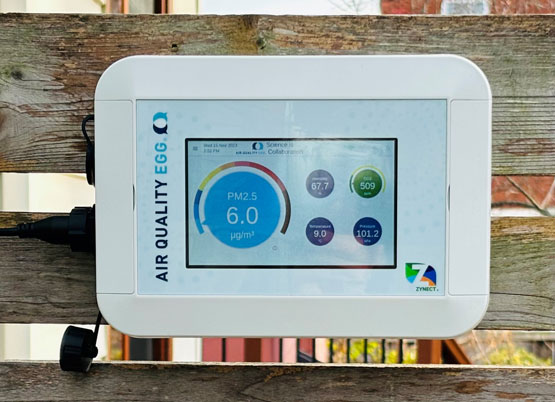
Low-cost sensors such as this one can provide immediate information on air quality and other environmental factors.
Now, low-cost air sensors are changing the game, especially for rural and remote communities. These lower-cost devices allow people to monitor air quality in their immediate surroundings. They offer scientists and governments another way to measure air quality in smaller and less accessible communities to fill gaps in the monitoring network. While they may not be as accurate as the regulatory monitors, they can still provide valuable information, especially in areas where regulatory monitoring stations aren’t available.
Currently, low-cost sensors are used to monitor fine particulate matter (called PM2.5) concentrations, one of the three air pollutants measured as part of the AQHI. Data from outdoor sensors can be accessed through platforms such as the AQMap, allowing anyone to easily access information about levels of PM2.5 in their area. Air quality can vary greatly over small areas, so having multiple low-cost sensors displayed together on the AQMap can provide useful information. However, it is important to note that the data from small sensors is not a representation of the full AQHI. The AQHI also includes measurements of other pollutants, in addition to PM2.5. As such, small sensors can help in communities who weren’t able to collect this data in the past, even if it provides less detailed information than the AQHI.
Harnessing the potential of low-cost sensors
Ryan Kulka, a researcher from Health Canada, is harnessing the potential of low-cost sensors in his work. By using data from these sensors, Ryan and his team are exploring the effects of wildfire smoke and heat on indoor air quality. With the help of their partners, they're also investigating how well ventilation systems in buildings and building envelopes themselves can filter out smoke during wildfires. “Every instrument has its role to play, and we are finding ways to use these low-cost sensors in our research,” says Ryan.
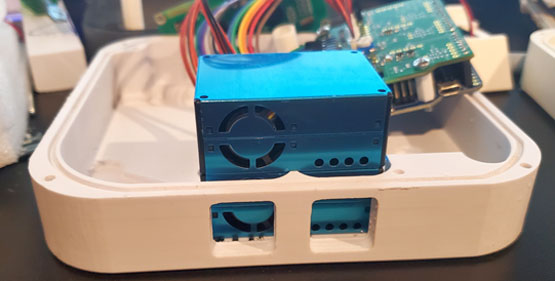
Low-cost sensors use one or more sensing elements to measure and report on air pollutants and environmental factors such as temperature and relative humidity.
With the help of low-cost sensors, researchers like Ryan are finding innovative ways to protect public health and improve air quality from coast to coast to coast. These sensors are available for purchase by provinces, territories, organizations, and individuals.
Low-cost air sensors are revolutionizing the way we monitor air quality. They empower individuals and communities to better understand their environment and contribute to a healthier future for all Canadians.