
August 2024 | Canadian Food Inspection Agency | by Rod Lister, Marie-Claude Gagnon Ph.D, and Bryn Shurmer
In late August 2022, Ontario public health authorities notified the Public Health Agency of Canada of 12 cases of an unknown foodborne illness in York, Ontario. Early observations from local public health authorities identified symptoms consistent with aconitine poisoning. Furthermore, they were able to link the illnesses to the consumption of restaurant-prepared meals that used locally purchased sand ginger as an ingredient. A case from March 2022 also showed signs of aconitine poisoning from a home-prepared meal.
What is Aconitine?
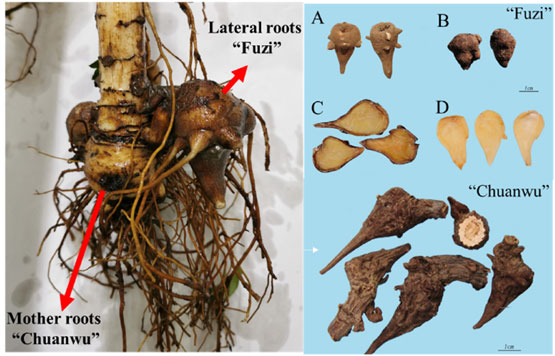
The appearance of raw (left) and commercial (right) roots of Aconitum carmichaelii; A – D show commercially prepared types of “Fuzi” roots for use in Chinese Herbal Medicine.
Aconitine derives from certain flowering plants from the Aconitum genus. More than 250 plant species are tied to the Aconitum line, which is native to the mountainous regions of the Northern Hemisphere. Commonly known as monkshood, wolfsbane and aconite, species are cultivated as ornamentals or for use in traditional herbal medicine. These plants and plant roots that contain alkaloid toxins and can cause severe illness, and even death.
CFIA Investigates
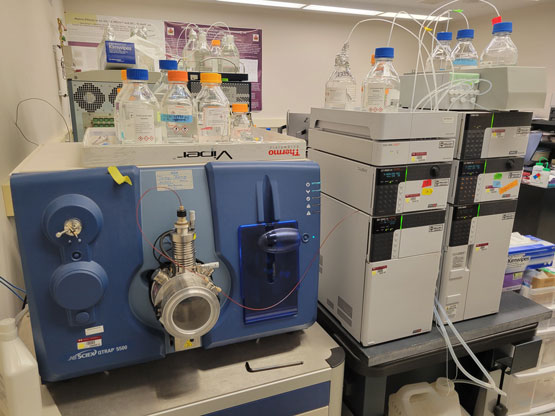
SCIEX 5500 QTRAP – a mass spectrometer that helps determine unknown compounds at a molecular level
When there are cases of foodborne illnesses, a collective of public health groups from all three levels (municipal, provincial and federal) of government get involved. In this specific incident, the Canadian Food Inspection Agency (CFIA) worked with the Fraser and York Region public health authorities, the British Columbia Centre for Disease Control and Ontario’s Ministry of Health. This group was assisted by the work of individual physicians, who treated patients who showed signs of illness.
The CFIA’s food safety investigation identified an imported spice product containing aconitine, as the cause of the illnesses. The spice was galanga powder (sand ginger), a powder similar to ginger commonly used in curries, soups and marinades.
As part of the overall investigation into these illnesses, two of CFIA’s diagnostic laboratories analyzed samples of sand ginger at both the genetic and chemical composition levels. Since this work was connected to an ongoing food safety investigation that included illnesses and hospitalizations, time sensitivity was an important factor.
Developing a methodology
To accomplish this, a fast quantitative/confirmatory analytical method for the determination of aconitine in spices by liquid chromatography and mass spectrometry (LC-MS/MS) was developed at the CFIA Saskatoon Laboratory. Liquid chromatography–mass spectrometry is an analytical chemistry technique that combines the physical separation capabilities of liquid chromatography with the mass analysis capabilities of mass spectrometry. Chromotography can provide precise analysis of samples, while using low volumes of samples.
This methodology was an adaptation of an existing in-house method for the analysis of a different toxin in plant material, and would be faster than developing another protocol. Through this process, it was determined that there were low levels of aconitine in the samples.
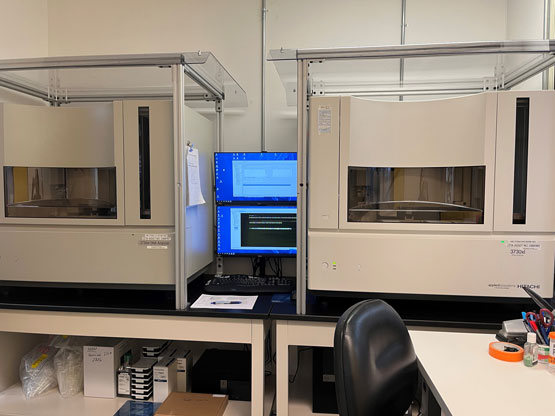
3730xl Genetic Analyzers – used to help determine the DNA of samples
Another key part of the investigation was DNA barcoding. DNA barcoding is a method of specimen identification using short, standardized segments of DNA. Every species has its own barcode, just as people have their own fingerprint. These DNA barcodes can be compared to a reference library to provide an ID. For the CFIA, this meant taking 15 samples of sand ginger and sending them to CFIA’s Genotyping-Botany Laboratory to test for the presence of Aconitum plant material.
So what did the results say?
Through both methods, the CFIA saw that all 15 samples tested (some randomly taken from retailers and others linked to the investigation) contained some level of aconitine. Interestingly enough, there was a wide variety in the levels. Some were less than 0.005ppm (parts per million), while the two suspect samples (taken from the potential source of the contamination) were up to 5900 and 6100 ppm respectively (see Annex A). To get an idea of how high 5900 and 6100 ppm is, Health Canada’s Bureau of Chemical Safety estimated aconitine exposure levels were potentially 600 times greater than what would be considered to have a toxic effect. Surprisingly, none of the samples tested contained DNA from Kaempferia galanga (sand ginger) despite being sold as this type of spice on the market. Other materials found in the samples included rice, cumin, avocado and dandelion. None of the samples taken at retailers contained toxic levels of aconitine.
What happened next?
The work of CFIA scientists showed there were indications of toxic levels of aconitine in the galanga powder used to prepare the meals that were eaten by those who got sick. This led CFIA’s Office of Food Safety and Recall (OFSR) to issue a recall of a specific brand of powder that was the source of the illnesses. In fact, the recalled product was mislabeled from the beginning. It was not galanga powder, as the labels said, but was Radix Aconiti Kusnezoffi Powder, a powder containing monkshood often used in traditional Chinese medicine.
Conclusions
This case is a good example of how multiple groups within the CFIA can collaborate using science as a means to solve challenging problems. By working together, the two CFIA labs developed a rapid analytical method able to detect a wide range of levels of aconitine. Using DNA barcoding, the CFIA was able to detect the presence of Aconitum sp. plant material in several of the samples tested.
Ultimately, these two innovative methods provided the CFIA with the evidence needed to pursue a recall of products linked to the illnesses.
Annex A – Test results using the method developed by CFIA
| Sample ID | Aconitine (ppm) | Ct value | ITS | psbA | rbcL |
|---|---|---|---|---|---|
| Sample 1 | 0.018 | 30.11 | Taraxacum officinale (98.06%) | Oryza eichingeri (99.64%) | Oryza punctata (99.03%) |
| Sample 2 | 0.018 | 28.94 | NA | Oryza rufipogon (99.10%) | Oryza sativa (98.75%) |
| Sample 3 | 0.014 | 22.73 | A. karakolicum (100.00%) | A. stylosum (96.19%) | Oryza punctata (98.55%) |
| Sample 4 | 0.019 | 21.73 | A. karakolicum (99.68%) | A. stylosum (98.11%) | Oryza sativa (98.75%) |
| Sample 5 | 0.017 | 29.69 | NA | NA | Oryza glaberrima (99.52%) |
| Sample 6 | 0.017 | 30.04 | NA | Persea americana (98.10%) | Oryza punctata (99.36%) |
| Sample 7 | 0.020 | 28.73 | NA | NA | Oryza glaberrima (99.52%) |
| Sample 8 | 0.030 | 22.22 | NA | A. flavum (97.81%) | Oryza punctata (99.52%) |
| Sample 9 | 0.015 | 25.51 | NA | NA | Oryza glaberrima (99.31%) |
| Sample 10 | 0.013 | 30.62 | NA | Actinidia chinensis (98.41%) | Machilus japonica (93.48%) |
| Sample 11 | 6100 | 13.23 | A. karakolicum (100.00%) | A. stylosum (98.38%) | A. kusnezoffii (99.68%) |
| Sample 12 | 5900 | 13.34 | A. karakolicum (100.00%) | A. stylosum (97.72%) | A. kusnezoffii (99.19%) |
| Sample 13 | <0.005 | 31.13 | Cuminum cyminum (100.00%) | Cuminum cyminum (99.65%) | Cuminum cyminum (99.68%) |
| Sample 14 | 0.010 | NA | NA | NA | NA |
| Sample 15 | <0.005 | 29.68 | Paeonia lactiflora (100.00%) | NA | Litsea cubeba (100.00%) |
| A. napellus | NA | 17.36 | A. napellus (100.00%) | A. kusnezoffii (97.31%) | A. napellus (100.00%) |
CT values = Cycle Threshold value
ITS = Internal Transcribed Spacer
psbA = photosystem II protein D1
rbcL = ribulose-1,5-bisphosphate carboxylase/oxygenase large subunit