
September 16, 2024
Chemicals are everywhere – in air, soil, water, products and food. And they can enter our bodies when we eat, breathe, and through our skin. Every day, we are exposed to a myriad of chemicals, whether they are human-made or occur naturally in the environment. In most cases, these chemicals are present at levels that pose no risk to our health, but scientists are determining whether we need to pay closer attention to specific chemicals and potential associated risks. Which is where human biomonitoring comes in!
In Health Canada’s laboratories, the work of Dr. Cariton Kubwabo and his team is vital to understanding the chemicals we are exposed to and if they may be negatively impacting our health and the environment.
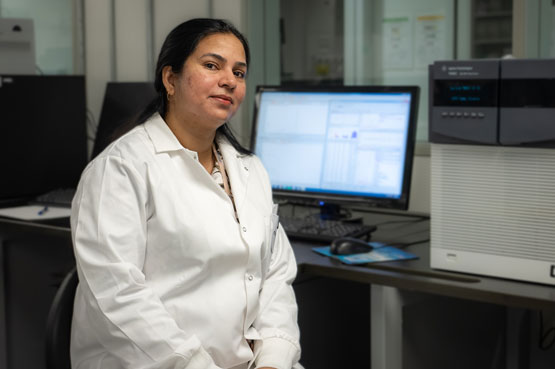
Dr. Shabana Siddique is part of the team that examines environmental contaminants at Health Canada.
“Our lab focuses on analyzing chemical contaminants that pose a potential risk to Canadians due to their presence in the environment and their toxicity,” explains Shabana Siddique, a scientist in Dr. Kubwabo’s lab.
Dr. Kubwabo’s team analyzes things like dust, water, or air to measure levels of chemicals in the environment as well as samples such as blood, urine, placental tissues and human milk to measure the level of chemicals in our body and what happens to them. These samples are voluntarily collected through large-scale surveys like the Canadian Health Measures Survey, which gathers a wide range of health information, biological samples, and environmental data from participants across the country. In many cases, this information is used to understand how people are exposed to various chemicals. “We spend a lot of time finding the right method and confirming that it will provide the results needed to make informed decisions,” says Shabana.
“We have state-of-the art analytical instruments that allow us to do our work,” adds Cariton, speaking about the equipment used to identify and quantify organic chemicals found at trace levels in environmental and biological samples.
From the lab to the real world
There is no shortage of interesting work for the team!
Several years ago, when vaping was new to Canada, it was Dr. Kubwabo’s lab that conducted some of the first chemical analyses on vaping liquids. The team identified about 1,500 chemicals in vaping liquids on the Canadian market.
Their lab was also involved in examining whether bisphenol A (BPA) from the plastic used to make baby bottles and sippy cups was leaching into the liquid that kids drink. The work supported setting regulations that banned the use of BPA in baby bottles. Since then, there has been a 96% decrease in exposure of infants to BPA!
Nowadays, the team is examining exposure to environmental contaminants to help estimate breast cancer risks in premenopausal women. The samples collected can be analyzed for a variety of contaminants to help determine whether exposure may increase breast cancer risk.
“I’m very proud to be part of this group, especially when I see that we are setting trends and that our work is being used around the world to inform our evaluation of risks posed by various substances,” says Shabana. Dr. Kubwabo concludes: “When we see our data being used nationally and internationally, it makes us happy!”