
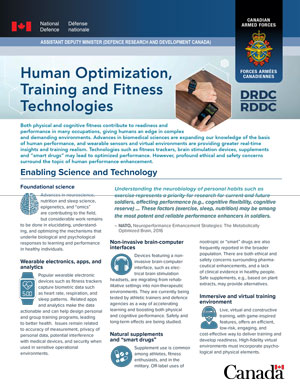
Download the alternative format
(PDF format, 333.29 KB, 2 pages)
Organizations: Produced in partnership by National Research Council Canada and Defence Research and Development Canada.
Published: 2023
Both physical and cognitive fitness contribute to readiness and performance in many occupations, giving humans an edge in complex and demanding environments. Advances in biomedical sciences are expanding our knowledge of the basis of human performance, and wearable sensors and virtual environments are providing greater real-time insights and training realism. Technologies such as fitness trackers, brain stimulation devices, supplements and “smart drugs” may lead to optimized performance. However, profound ethical and safety concerns surround the topic of human performance enhancement.
Enabling science and technology
Foundational science
Advances in neuroscience, nutrition and sleep science, epigenetics, and “omics” are contributing to the field, but considerable work remains to be done in elucidating, understanding, and optimizing the mechanisms that underlie biological and psychological responses to learning and performance in healthy individuals.
Wearable electronics, apps, and analytics
Popular wearable electronic devices such as fitness trackers capture biometric data such as heart rate, respiration, and sleep patterns. Related apps and analytics make the data actionable and can help design personal and group training programs, leading to better health. Issues remain related to accuracy of measurement, privacy of personal data, potential interference with medical devices, and security when used in sensitive operational environments.
Non-invasive brain-computer interfaces
Devices featuring a non- invasive brain-computer interface, such as electrical brain stimulation headsets, are migrating from rehabilitative settings into non-therapeutic environments. They are currently being tested by athletic trainers and defence agencies as a way of accelerating learning and boosting both physical and cognitive performance. Safety and long-term effects are being studied.
Natural supplements and “smart drugs”
Supplement use is common among athletes, fitness enthusiasts, and in the military. Off-label uses of nootropic or “smart” drugs are also frequently reported in the broader population. There are both ethical and safety concerns surrounding pharma- ceutical enhancements, and a lack of clinical evidence in healthy people. Safe supplements, e.g., based on plant extracts, may provide alternatives.
Immersive and virtual training environment
Live, virtual and constructive training, with game-inspired features, offers an efficient, low-risk, engaging, and cost-effective way to deliver training and develop readiness. High-fidelity virtual environments must incorporate psychological and physical elements.
“Understanding the neurobiology of personal habits such as exercise represents a priority for research for current and future soldiers, affecting performance (e.g., cognitive flexibility, cognitive reserve) … These factors (exercise, sleep, nutrition) may be among the most potent and reliable performance enhancers in soldiers.”
Signals
Academic
The University of São Paulo (Brazil) and the University of Queensland (Australia) are leaders in physical education and supplements research. Canada’s McMaster University is another top player. In the area of cognitive and other bio-enhancement techniques, Harvard Medical School, Oxford University, and the University of Toronto have strong research profiles.
Government
The U.S. Department of Defense and NASA have ongoing research programs in the area of human performance metrics and optimization, neuromodulation and the brain-computer interface, and training simulations. The U.S. BRAIN initiative and Europe’s Human Brain Project sponsor and coordinate private-public research in neuroscience and related technologies.
Collaboration
The Houston Serious Games Research Consortium promotes games for business, health, and education. The Consortium for Military Health and Performance (CHAMP) is the U.S. Department of Defense Center of Excellence for integration, translation and education in the area of human performance optimization and total force fitness.
Non-governmental organization (NGO)
The Allen Institute for Brain Science (Seattle) is a leader in fundamental neuroscience, including molecular studies and cortical circuitry. Research and technology organizations such as the Fraunhofer Institute for Computer Graphics Research (Germany) and Korea Institute of Science and Technology are exploring novel applications for virtual and augmented reality in occupational settings.
Corporate
Enterprises such as Facebook, Google, Microsoft, and Cubic Corporation are active in virtual reality and training simulations, and a host of companies manufacture fitness devices and apps (e.g., Garmin, FitBit®, Jawbone, Nike). Recent participants in trials of brain stimulation devices include Halo Neuroscience, Thync, and HRL Laboratories.
“Globally, the trend for human enablement/enhancement technologies has seen a rise; however, there is a huge scope for such technologies to be introduced to the masses.”
Impact
Social
The issue of human performance enhancement raises profound ethical questions. There are also significant health, safety, and privacy/security concerns associated with supplements, pharmaceutical enhancement, and remote monitoring. On the plus side, fitness innovations can counter the effects of sedentary lifestyles and the obesity epidemic.
Policy
The regulatory framework struggles to keep abreast of developments in medical-grade wearable electronics, nutraceuticals, and brain-computer interfaces.
Economic
Employers in occupations with high physical/cognitive performance requirements will need to achieve cost efficiencies and accelerate training timelines while ensuring that training matches complex operational demands. There is also a lack of affordable electronic fitness devices with higher-end functionality.
Environmental
A proliferation of devices such as fitness trackers/wearables raises concern with regard to availability and ethical sourcing of rare earths and minerals used in components and proper end-of-life disposal of used electronics. Novel battery formats may be more efficient and environmentally friendly.
Defence
Defence agencies must match training activities and metrics to well-defined functional requirements. Shrinking budgets will favour increasing adoption of virtual training environments. Total force fitness and enhanced performance requires a holistic approach that recognizes behavioural, social, physical, psychological, and other factors.
“Cutting-edge biomedical technologies that could push the boundaries of human abilities may soon be available, making people’s minds sharper and their bodies stronger and healthier than ever before… The public expresses more worry than enthusiasm about each of these potential human enhancements.”
Contact information
Produced in partnership by the National Research Council of Canada and Defence Research and Development Canada.
November 2016 · Également disponible en français
© His Majesty the King Right of Canada as represented by the Minister of National Defence, 2023
Cat. No.: D69-79/2023E-PDF
ISBN: 978-0-660-49808-9